India Travel Guide for First-Time Visitors: The Golden Triangle + Varanasi (2026)
India is the kind of place that rewrites you. But for a first-time visitor, it can also overwhelm you — fast.
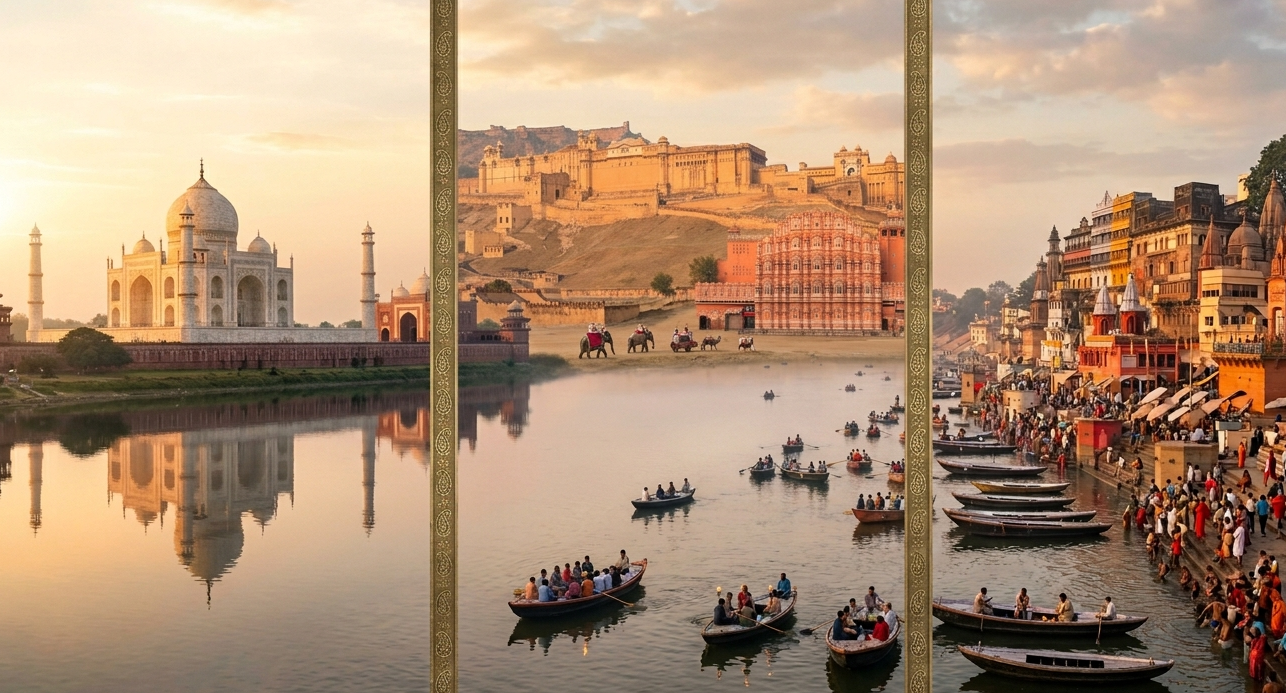
The Golden Triangle (Delhi → Agra → Jaipur) plus Varanasi is the most-traveled first-timer’s route in India, and for good reason: it packs 3,000 years of history, three UNESCO World Heritage Sites, and the most spiritually intense city on earth into a single connected journey.
According to India’s Ministry of Tourism, over 6.4 million foreign tourists visited India in 2023, with the Golden Triangle cities accounting for the highest footfall of any domestic travel corridor. This guide gives you exactly what you need to navigate it — without the overwhelm.
What you’ll find here:
- A day-by-day itinerary for 10–12 days
- What to see, eat, and skip in each city
- Visa requirements, transport between cities, and budget breakdowns
- Practical safety and health tips
- A full FAQ for common first-timer questions
What Is the Golden Triangle + Varanasi Route?
The Golden Triangle is a travel circuit connecting three cities in northern India: Delhi (the capital), Agra (home of the Taj Mahal), and Jaipur (the Pink City of Rajasthan). The three cities form a rough triangle on the map, each approximately 230–280 km apart.
Varanasi is commonly added as a fourth stop — a 12-hour overnight train from Jaipur. It’s one of the world’s oldest continuously inhabited cities and Hinduism’s holiest pilgrimage site, sitting on the banks of the Ganges River.
Together, the four cities give first-time visitors the full spectrum of India: Mughal empire grandeur, Rajput palaces, colonial chaos, and ancient spiritual ritual — all within one manageable route.
How Long Do You Need?
The minimum recommended time for this route is 10 days. A 12-day trip is ideal.
| City | Recommended Days | Why |
|---|---|---|
| Delhi | 2–3 days | Multiple UNESCO sites, neighborhoods, food scene |
| Agra | 1–2 days | Taj Mahal + Agra Fort; limited after that |
| Jaipur | 2 days | Amber Fort, City Palace, bazaars, day trips |
| Varanasi | 2 days | Ghats, Ganga Aarti ceremony, morning boat ride |
| Transit buffer | 1 day | Flight delays, train connections, rest |
| Total | 10–12 days |
Trying to do this in under 8 days is the most common mistake first-timers make. You will spend 2–3 of those days in transit. Give yourself breathing room.
Recommended Itinerary: 12 Days
Days 1–3: Delhi
Delhi is not a warm welcome — it’s a full-body collision with one of the world’s most intense cities. Give it 3 days to reveal itself.
Day 1 — Old Delhi
Start in Chandni Chowk, the 17th-century market district near the Red Fort. Walk through the spice market (Khari Baoli), eat breakfast at Paranthe Wali Gali (the alley of stuffed flatbreads, open since 1875), then hire a cycle-rickshaw through the lanes.
In the afternoon, visit the Jama Masjid — India’s largest mosque, built by Mughal emperor Shah Jahan in 1656 and capable of holding 25,000 worshippers. Entry is free; modest dress required.
Skip: the Red Fort interior galleries if time is tight. The fort’s exterior and the surrounding markets are more memorable.
Day 2 — New Delhi + Humayun’s Tomb
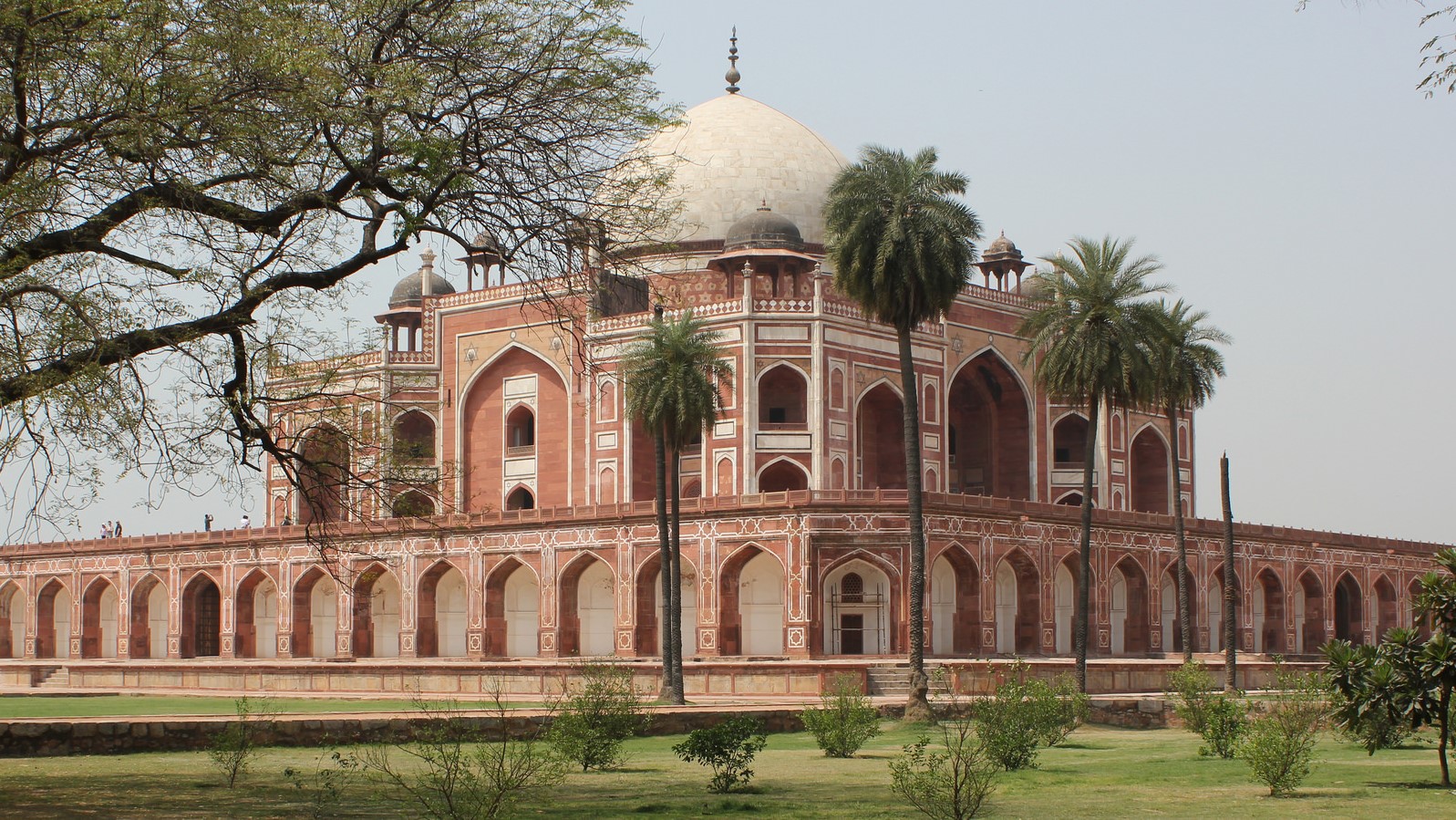
Humayun’s Tomb (1570 CE) is the architectural prototype that inspired the Taj Mahal and is 75% less crowded. Entry: INR 600 (~$7 USD) for foreigners.
Afternoon: walk through the Lodhi Garden — 90 acres of 15th-century tombs set inside a public park. Free entry. One of Delhi’s most underrated spots.
Evening: dinner in Hauz Khas Village or Khan Market.
Day 3 — Qutb Minar + Departure Prep
The Qutb Minar (1193 CE) is the world’s tallest brick minaret at 72.5 metres and another UNESCO site. Spend 2 hours here in the morning.
Afternoon: rest, laundry, confirm Agra transport.
Where to stay in Delhi: Paharganj (budget, backpacker hub near New Delhi Railway Station), Connaught Place (mid-range, central), or Lutyens’ Delhi / South Delhi (premium).
Days 4–5: Agra
Agra’s single unmissable sight is the Taj Mahal. Everything else is secondary.
Day 4 — Taj Mahal at Sunrise
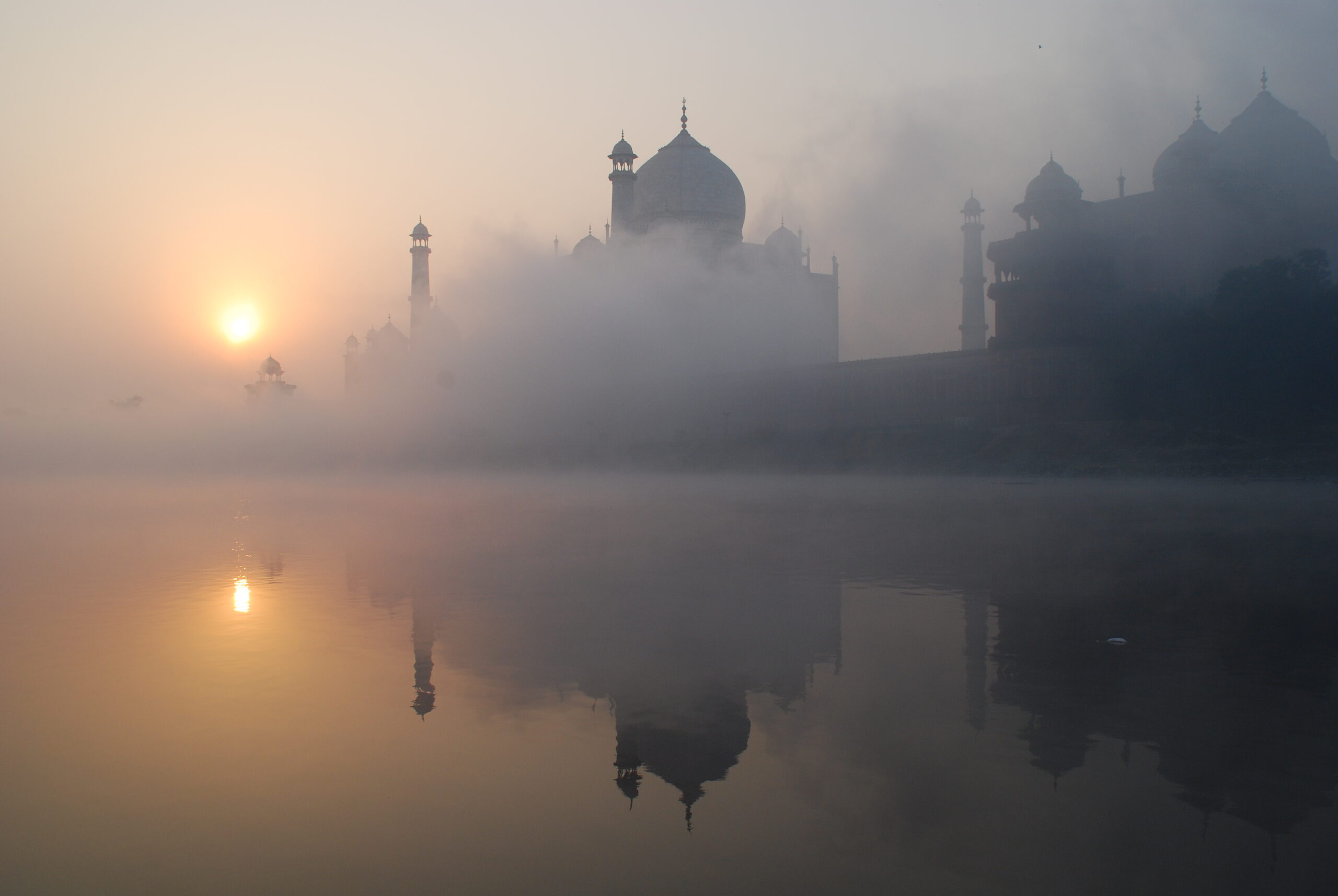
The Taj Mahal opens 30 minutes before sunrise. Arrive at the East Gate by 5:45 AM. You’ll have an hour before the first tour buses arrive.
Self-Contained Answer: The Taj Mahal was built between 1632 and 1653 by Mughal emperor Shah Jahan as a mausoleum for his wife Mumtaz Mahal. It took 22 years, 20,000 workers, and materials from 22 countries to complete. Entry costs INR 1,100 (~$13 USD) for foreign visitors; the fee includes shoe covers and a 500ml water bottle.
Spend 2–3 hours. Return at sunset if you want a second perspective — the light shifts dramatically.
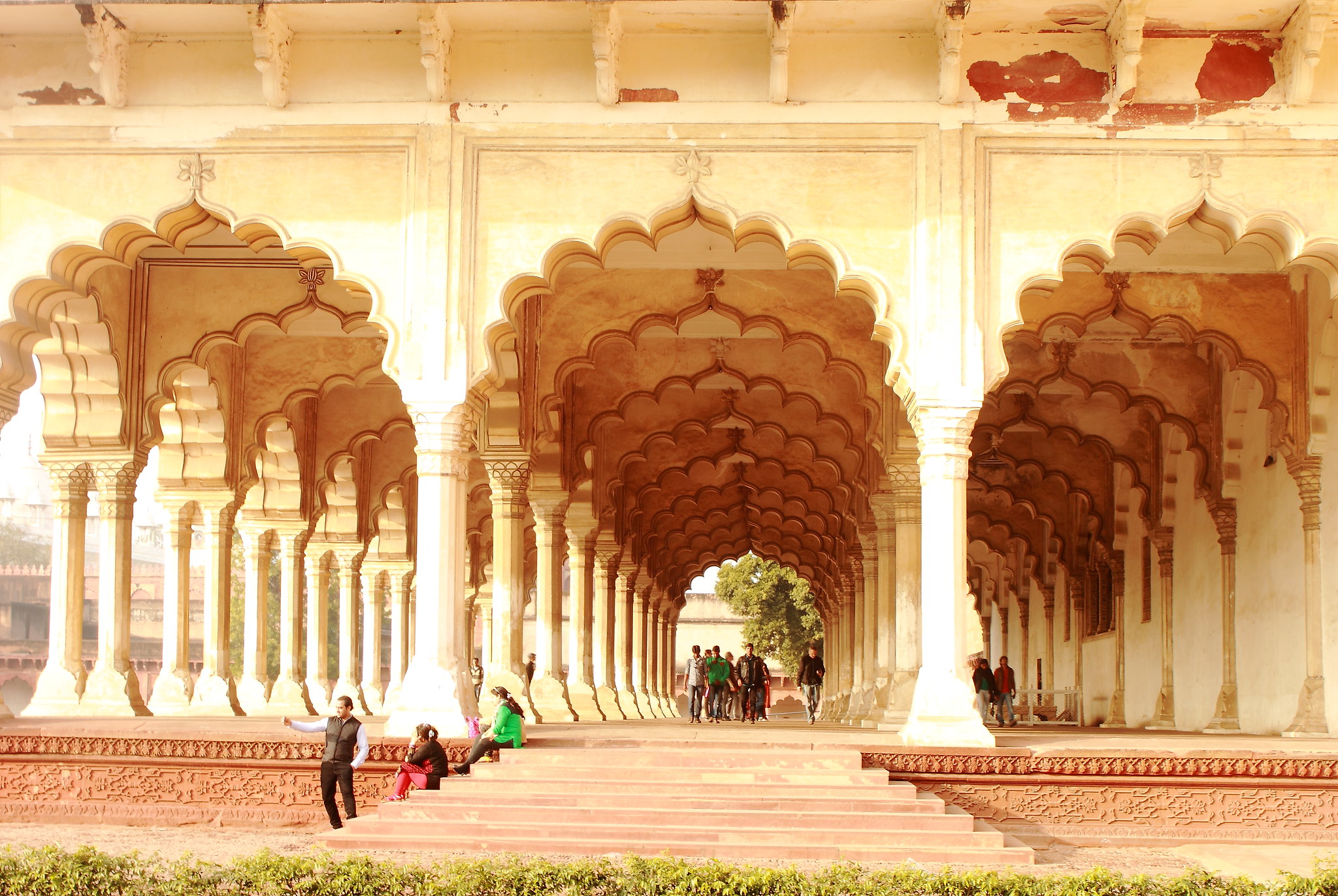
Agra Fort (afternoon): A 16th-century UNESCO site 2.5 km from the Taj, where Shah Jahan was imprisoned by his son and spent his final years looking at the Taj Mahal through a window. Entry: INR 650.
Day 5 — Fatehpur Sikri (optional) + Departure to Jaipur
If leaving on an afternoon train, spend the morning at Fatehpur Sikri — a perfectly preserved abandoned Mughal capital 40 km from Agra, built in 1571 and deserted within 15 years. Few tourists make the detour. It’s worth it.
Where to stay in Agra: Stay near the Taj Mahal’s East or South Gate for early morning access. The Oberoi Amarvilas (if budget allows) has rooms facing the Taj. Mid-range: Trident Agra.
Days 6–7: Jaipur
Jaipur, the capital of Rajasthan, is called the Pink City because its old town buildings were painted terracotta pink in 1876 to welcome the Prince of Wales. The color ordinance still applies today.
Day 6 — Amber Fort + City Palace
Amber Fort (16th century) is the most impressive fort in Rajasthan. Set on a hillside 11 km from Jaipur, it combines Hindu and Mughal architecture across four courtyards. Allow 3 hours. Entry: INR 500 for foreigners.
Arrive by 9 AM before the heat and crowds build.
Afternoon: City Palace in the old city — still partially inhabited by the royal family of Jaipur. The textile and weapons museums inside are genuinely exceptional.
Day 7 — Jantar Mantar + Bazaars
Jantar Mantar (1734 CE) is the world’s largest stone sundial complex and an UNESCO site. It measures time to within 2 seconds of accuracy using 19 astronomical instruments. Entry: INR 200. Allow 1 hour with a guide.
Afternoon: shop or browse in Johari Bazaar (jewelry), Bapu Bazaar (textiles), and Nehru Bazaar (footwear). Jaipur is India’s best city for buying handicrafts.
Where to stay in Jaipur: Inside the old walled city for atmosphere; near MI Road for convenience. Heritage hotels (havelis converted to guesthouses) offer better character than chain hotels at similar prices.
Days 8–9: Varanasi
Varanasi will be unlike anything you’ve experienced. It’s Hinduism’s holiest city — a place where the living come to pray and the dying come to achieve moksha (liberation from the cycle of rebirth). Open cremations take place on the riverbank 24 hours a day.
“Varanasi is older than history, older than tradition, older even than legend, and looks twice as old as all of them put together.” — Mark Twain, Following the Equator (1897)
Getting there: Overnight train from Jaipur (Marudhar Express or similar, 11–12 hours) or fly via Delhi (faster but expensive). Book train tickets at least 2–3 weeks ahead on IRCTC.
Day 8 — Ghats + Ganga Aarti
The ghats are the stone steps descending to the Ganges — there are 88 of them, each with a different ritual purpose. Spend the morning walking from Assi Ghat north toward Dashashwamedh Ghat, stopping wherever you’re drawn.
Dashashwamedh Ghat hosts the Ganga Aarti ceremony at sunset — a 45-minute fire ritual performed by priests simultaneously at 7 lit platforms, drawing thousands of worshippers and visitors. Arrive 30 minutes early for a good viewing position.
Etiquette note: Manikarnika Ghat is the main cremation ghat. Photography here is deeply disrespectful. Do not photograph. Walk quietly.
Day 9 — Sunrise Boat Ride + Sarnath
Book a rowing boat for sunrise on the Ganges. From the water, the full panorama of the ghats reveals itself as the city wakes — morning prayers, pilgrims bathing, marigold offerings floating downstream. Cost: INR 200–500 (negotiate before boarding).
Afternoon: Sarnath, 10 km from Varanasi — the site where the Buddha gave his first sermon after achieving enlightenment in 528 BCE. The Dhamek Stupa (500 CE) and museum hold some of India’s finest Buddhist artifacts. Entry: INR 40.
Where to stay in Varanasi: Hotels near the ghats give the most authentic experience. Bhadaini and Assi Ghat areas offer the best balance of atmosphere and accessibility.
Practical Information for First-Time Visitors
Visa
Most nationalities apply for an Indian e-Visa (eTV) online at the official portal (indianvisaonline.gov.in). Cost: $25–$80 depending on nationality. Valid for 60–180 days. Approved within 72–96 hours. Apply at least one week before departure.
Citizens of 57 countries are eligible. The US, UK, Australia, Canada, and EU countries all qualify.
Getting Between Cities
| Route | Best Option | Journey Time | Approx. Cost |
|---|---|---|---|
| Delhi → Agra | Gatimaan Express train | 1h 40min | INR 750 (~$9) |
| Agra → Jaipur | Train or private car | 4h / 4.5h | INR 300–500 |
| Jaipur → Varanasi | Overnight train | 11–12h | INR 400–1,200 |
| Delhi → Varanasi | Domestic flight (alternate) | 1h 30min | $40–$90 |
Book trains on IRCTC (irctc.co.in) — foreign tourists have a dedicated quota. For private car hire across the full Golden Triangle, expect INR 15,000–25,000 (~$180–$300) for a driver for 5–6 days.
Budget Guide
| Budget Level | Daily Spend | What It Gets You |
|---|---|---|
| Budget | INR 2,000–3,500 (~$25–$42) | Hostel dorm, street food, local transport |
| Mid-range | INR 5,000–10,000 (~$60–$120) | 3-star hotel, sit-down restaurants, Uber/Ola |
| Comfort | INR 15,000–30,000 (~$180–$360) | Heritage hotels, guided tours, AC everywhere |
Health and Safety
- Drink only sealed bottled water. Tap water is not safe for visitors.
- Carry oral rehydration salts (widely sold at Indian pharmacies). Delhi Belly affects roughly 30–40% of first-time visitors according to travel health data from the Fit for Travel database.
- Travel insurance is non-negotiable. Medical evacuation from India can cost $30,000–$80,000 without coverage.
- Use Ola or Uber for all cab rides in cities — no negotiation, no scams, GPS-tracked.
- ATMs: HDFC, ICICI, and SBI ATMs are the most reliable for foreign cards. Withdraw in larger amounts (INR 10,000+) to minimize transaction fees.
What to Pack
- Modest clothing: Cover shoulders and knees at temples, mosques, and cremation ghats
- Solid-soled shoes you can slip off easily (shoes come off at every religious site)
- Small padlock for hostel lockers and train compartment door
- Power adapter (Type C/D/M; India runs on 230V/50Hz)
- Offline maps: Download Google Maps or Maps.me for your cities before arrival
Best Time to Visit
October to March is the optimal window for the Golden Triangle and Varanasi. Days are dry and clear, temperatures are 10–25°C (50–77°F), and major festivals fall within this period.
| Month | Conditions | Notes |
|---|---|---|
| October–November | Warm days, cool nights | Diwali Festival (Oct/Nov) — spectacular |
| December–January | Cool to cold | Peak tourist season; book ahead |
| February–March | Pleasant, warming | Holi Festival (March) — unmissable if timing aligns |
| April–May | Hot, building to extreme | Agra hits 40°C+; tolerable early April |
| June–September | Monsoon season | Delhi and Agra manageable; Varanasi atmospheric but wet |
The One Thing Every First-Timer Gets Wrong
Most people try to rush this route. They book 8 days, cram it all in, and spend half their trip exhausted on trains. India rewards slowness. The best moments — a conversation with a chai vendor in Varanasi, stumbling into a wedding procession in Jaipur’s old city, watching the Taj Mahal change color as the sun sets — don’t appear in itineraries.
Build in blank time. Budget for a rest day. Let India happen to you.